
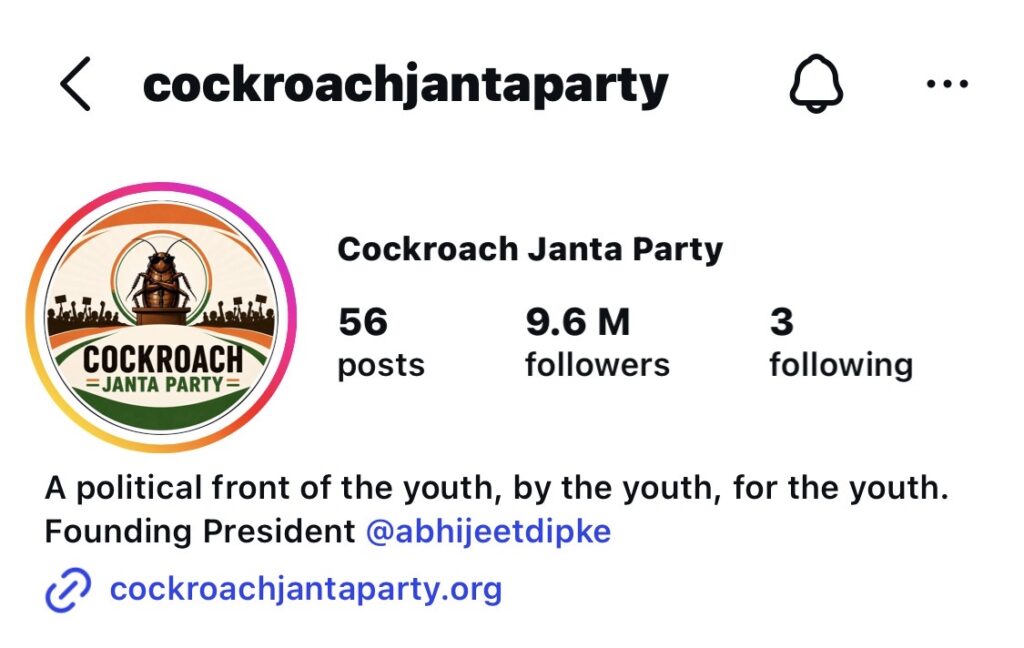
If you’ve opened Instagram over the last few days, your feed has likely been invaded by a swarm of digital roaches. No, it’s not a glitch, and no, pest control won’t help. You are witnessing the explosive, chaotic, and unprecedented rise of the Cockroach Janta Party (CJP).
What started as a late-night internet joke has ballooned into a massive digital rebellion, crossing over 9 million followers on Instagram in just four days—effectively out-pacing mainstream political heavyweights like the Aam Aadmi Party (1.9M) and even the ruling BJP (8.7M) in the IG numbers game.
But what exactly is the CJP, who is pulling the strings, and does it actually matter to India’s youth? Let’s unwrap the madness.
The Origin Story: How an Insult Sparked an “Infestation”
Every great movement needs a catalyst, and for the CJP, it came from the highest echelons of power. During a Supreme Court hearing, Chief Justice of India Surya Kant reportedly made a passing comment comparing some unemployed youths who enter professions like journalism, social media, or RTI activism to “cockroaches” and “parasites” who start attacking the system.
While the CJI later clarified that his remarks were misquoted and aimed specifically at individuals using fake degrees, the damage was already done in the court of public opinion.
Instead of getting defensive, India’s “chronically online” youth did what they do best: they weaponized the insult. If the system views struggling, unemployed, or frustrated young people as cockroaches, then cockroaches they shall be.
However, there is a political connection that explains why the page is so brilliantly executed. The “Founding President” of the CJP is Abhijeet Dipke, a 30-year-old digital strategist from Maharashtra who recently finished his Master’s at Boston University. Before heading to the US, Dipke actually worked in the social media team for the Aam Aadmi Party (AAP) between 2020 and 2022.
So, while AAP hasn’t funded or institutionalized the movement, the strategic, meme-driven DNA of modern political campaigning is clearly present.
As for the Indian National Congress (INC) or other opposition parties? They aren’t pulling the strings, but they are absolutely enjoying the show. High-profile opposition politicians like Mahua Moitra and Kirti Azad (TMC), and Akhilesh Yadav (SP) have publicly interacted with the CJP on X (formerly Twitter), jokingly asking to join.
“Secular, Socialist, Democratic, Lazy”: The Manifesto
The CJP’s bio reads: “A political front of the youth, by the youth, for the youth.” Its official eligibility criteria state you must be “unemployed by force, choice, or principle,” spend 11+ hours online, and possess the ability to “rant professionally.”
Yet, beneath the hyper-satirical surface, the CJP’s 5-point manifesto tackles genuine, deep-seated youth anxieties with surprising seriousness:
No Post-Retirement Rewards: A ban on Chief Justices taking Rajya Sabha seats after retirement.
Accountability in Voting: Demanding severe penalties for election officials if legitimate voter names are deleted from rolls.
Women’s Representation: A strict 50% reservation for women in Parliament and the Cabinet.
Anti-Defection: A 20-year ban from public office for any politician who switches parties mid-term.
Student Advocacy: Calling out exam corruption (like the ongoing NEET controversies) and demanding CBSE scrap rechecking fees.
Does This Matter to India’s Gen Z, or is it Just a US-Based Meme Page?
Because Abhijeet Dipke recently studied in Boston, some initially wondered if this was just an isolated, NRI-driven internet stunt. But the physical reality on the ground has quickly proven otherwise. The movement has already clocked over 1.6 lakh official “registrations” via a Google Form, and young volunteers in India have already started hitting the ground, conducting cleanliness drives at garbage sites while holding placards that read, “I Am A Cockroach.”
Does an Instagram page translate to real-world political power? Skeptics are already pointing out that “double-tapping a reel doesn’t equal casting a vote.”
But to dismiss the Cockroach Janta Party as just a silly trend misses the forest for the trees. The CJP is a mirror to India’s Gen Z. It reflects a generation that is deeply disillusioned by mainstream politics, exhausted by paper leaks, anxious about job scarcity, and tired of being talked down to by older generations in power.
By wrapping their rage in a layer of thick, absurd satire, India’s youth have built a digital ecosystem where they finally feel heard. It might not win an election tomorrow, but it has proven one thing: you can’t underestimate a generation that knows how to turn a bureaucratic insult into a 9-million-strong cultural roar.